As an Amazon Associate I earn from qualifying purchases (at no additional cost to you). Regardless, I only recommend products I personally use and love. If you’re shopping on Amazon this week, please consider starting at my link. A small percentage of anything you buy supports my small business at no cost to you. Thank you for supporting my dream business!
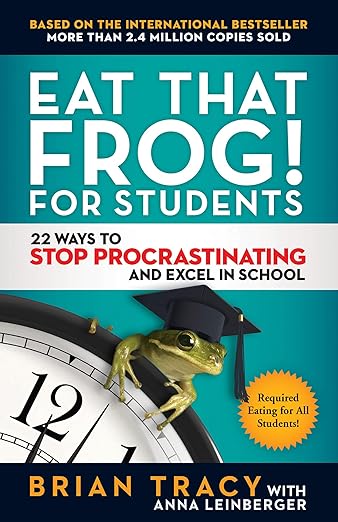
Eat that Frog! For Students: 22 Ways to Stop Procrastinating and Excel in School by Brian Tracy
I absolutely love Eat that Frog! for Students book for students who struggle with procrastination, how to prioritize their workload…basically any student 🙂
Here’s the Setup
Adapted from Brian Tracy’s international time-management bestseller, Eat That Frog!, this book will give today’s stressed-out and overwhelmed students the tools for lifelong success.
Like adults, students of all ages struggle with how to manage their time. Encountering the necessity of time management for the first time, high schoolers juggle classes, extracurricular activities (all but mandatory for college admissions), jobs, internships, family responsibilities, and more. College brings even more freedom and less structure, making time management even more critical.
Brian Tracy’s Eat That Frog! has helped millions around the world get more done in less time. Now this life-changing global bestseller has been adapted to the specific needs of students. Tracy offers readers tips, tools, and techniques for structuring time, setting goals, staying on task (even when you’re not interested), dealing with stress, and developing the skills to achieve far more than you ever thought possible. This is the book that parents and teachers have long been wishing Tracy would write.
My Takeaways
With the many resources available to students today, they are more in charge of their own learning than ever!
“your ability to take action without a study hall or a parent’s reminders will be the single most impactful factor in whether you succeed in your classes. It is important to begin building these habits as soon as possible. The earlier you start, the easier maintaining these habits will be throughout your life”
pg. 5
Students need to learn how to manage their own schedule while in high school–it is crucial for future success.
“Taking responsibility is one of the best things about growing up. From this point forward, you get to make every decision and determine for yourself every action you take. Your life and choices are now your responsibility and in your control” (pg. 20).
Understanding this, and not blaming others for choices that the student made, will go far.
And of course, the name of the book- “Eat That Frog!” Do your hardest task first thing (at the beginning of the day, or at least at the beginning of your study time). Get it done, so it’s not hanging over your head. You get a confidence boost from having done it. As your energy wanes, your easier / more enjoyable tasks are waiting.
Age Recommendation
Middle school and up will find this helpful! Also, I would suggest that parents read this with their child to help support them learning to plan their own workload! This book is short and accessible.
Used by Google Analytics to determine which links on a page are being clicked
30 seconds
_ga_
ID used to identify users
2 years
_gid
ID used to identify users for 24 hours after last activity
24 hours
_gat
Used to monitor number of Google Analytics server requests when using Google Tag Manager
1 minute
_gac_
Contains information related to marketing campaigns of the user. These are shared with Google AdWords / Google Ads when the Google Ads and Google Analytics accounts are linked together.
90 days
__utma
ID used to identify users and sessions
2 years after last activity
__utmt
Used to monitor number of Google Analytics server requests
10 minutes
__utmb
Used to distinguish new sessions and visits. This cookie is set when the GA.js javascript library is loaded and there is no existing __utmb cookie. The cookie is updated every time data is sent to the Google Analytics server.
30 minutes after last activity
__utmc
Used only with old Urchin versions of Google Analytics and not with GA.js. Was used to distinguish between new sessions and visits at the end of a session.
End of session (browser)
__utmz
Contains information about the traffic source or campaign that directed user to the website. The cookie is set when the GA.js javascript is loaded and updated when data is sent to the Google Anaytics server
6 months after last activity
__utmv
Contains custom information set by the web developer via the _setCustomVar method in Google Analytics. This cookie is updated every time new data is sent to the Google Analytics server.
2 years after last activity
__utmx
Used to determine whether a user is included in an A / B or Multivariate test.